QLD Child Safety Lead Officer Workshop

Supporting Organisational Leaders and Child Safety Officers to Implement the Child Safe Standards

QLD Child Safety Lead Officer Workshop

Development funded by the Queensland Family and Child Commission’s Child Safeguarding Grants Program.

Queensland Family and Child Commission logo

Course Overview

Queensland organisations are now required to strengthen the way they protect children and young people through the new Child Safe Organisations system. For many organisations, the challenge is not simply understanding the 10 Child Safe Standards. It is ensuring there is a capable person within the organisation who can coordinate implementation, influence leaders, support staff and volunteers, and help translate child safety commitments into everyday practice.

The Child Safety Lead Officer plays a critical role in bringing together policy, practice, culture, risk management, reporting and continuous improvement. They are often the key link between frontline staff, senior leaders, Boards, children and families, and—where relevant—external regulators.

The Child Safety Lead Officer Workshop is a practical, facilitator-led two-day program designed to help current and emerging Child Safety Lead Officers build the confidence, knowledge and practical tools needed to lead implementation of Queensland’s Child Safe Standards and the Universal Principle.

Participants will work through realistic scenarios, organisational self-reflection, risk and reporting exercises, implementation tools and practical action planning. The workshop is designed to support organisations at different stages of their child safety journey, from those beginning implementation through to those strengthening existing systems and preparing for ongoing assurance.

For organisations that are required to participate in Queensland’s Reportable Conduct Scheme, the workshop also provides a practical introduction to the role of Child Safety Lead Officers in supporting organisational readiness, reporting pathways, record keeping and response processes.
ENQUIRE ABOUT TRAINING

Attend a Public Workshop

Join an upcoming live QLD Child Safety Lead Officer Workshop and gain practical skills for leading child safety in your organisation.

Is Your Organisation Ready?

As Queensland’s Child Safe Standards become embedded across organisations:

  • Is your Child Safety Lead Officer role clearly defined, supported and understood?
  • Does your organisation understand how the 10 Child Safe Standards apply to its services, programs and environments?
  • Are leaders and Boards receiving meaningful information about child safety risks, incidents and improvement priorities?
  • Does your organisation have practical policies, procedures and tools that staff and volunteers can confidently use?
  • Are children, young people and families able to participate and raise concerns in ways that are safe, accessible and meaningful?
  • Does your organisation actively support cultural safety for Aboriginal and Torres Strait Islander children, young people, families and communities?
  • Are your physical, online, organisational and workforce risks being identified and managed?
  • Are reporting, incident response and record-keeping processes clear and effective?
  • Does your organisation have a realistic plan for strengthening child safety over the next 90 days?

This workshop helps organisations answer these questions before an incident occurs.

Ideal Participants

This course is designed for:

  • Child Safety Lead Officers, Child Safety Officers and Safeguarding Officers
  • Child Protection Officers and Child Safety Coordinators
  • Senior leaders, program managers and operational managers
  • People and Culture, HR and recruitment personnel
  • Governance, risk and compliance professionals
  • Team leaders and supervisors with child safety responsibilities
  • Volunteer coordinators and program coordinators
  • Staff responsible for reporting, incident management, complaints or risk management
  • Emerging child safety leaders preparing to take on a formal lead role

Participants Will:

✔ Understand the Queensland Child Safe Organisations system, including the 10 Child Safe Standards and the Universal Principle.

✔ Clarify the purpose, scope, authority and responsibilities of the Child Safety Lead Officer role.

Apply the Queensland Child Safe Standards to their organisation’s services, programs, environments and workforce.

✔ Identify practical ways to strengthen cultural safety for Aboriginal and Torres Strait Islander children, young people, families and communities.

Build confidence in influencing Boards, Executive Leaders, managers, staff and volunteers.

Assess whether policies, procedures and reporting pathways are practical, accessible and embedded in everyday systems.

Respond more confidently when child safety concerns, disclosures, allegations or possible harm are identified.

Identify physical, behavioural, organisational, cultural and online child safety risks.

✔ Use incident reviews, records and risk information to support continuous improvement.

✔ Develop practical early actions and a 90-day implementation plan aligned with Queensland requirements.

Course Structure

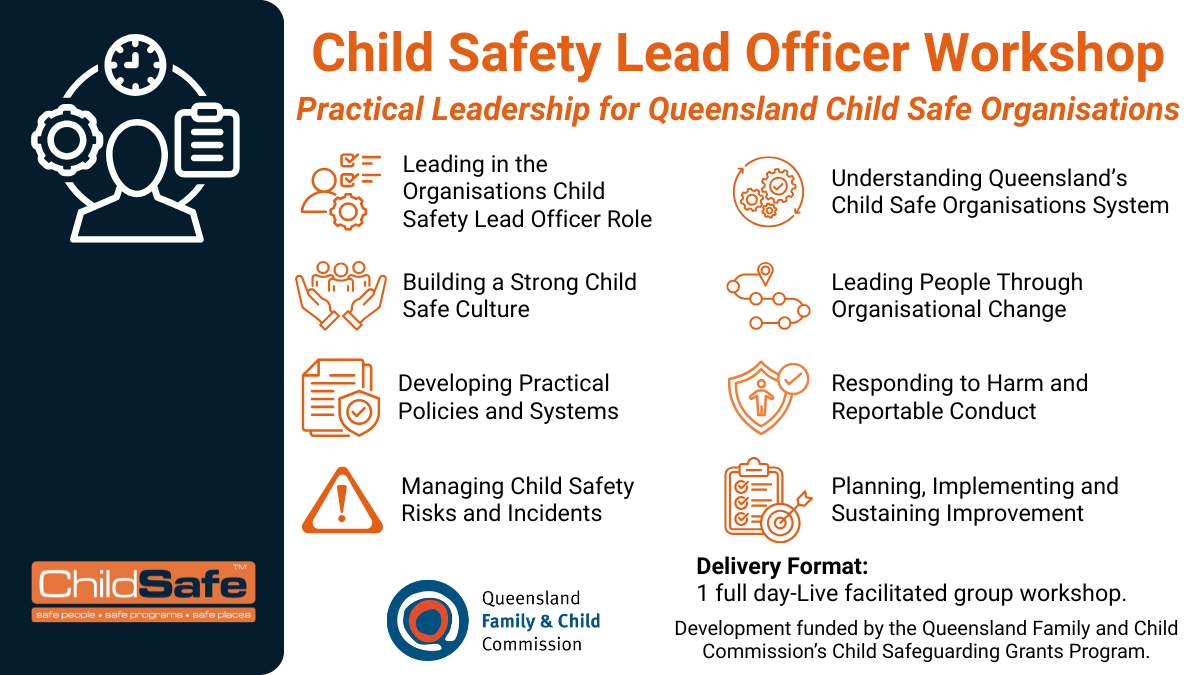
Section 1 – The Role of the Child Safety Lead Officer

  • Purpose, scope and responsibilities of the role
  • Strategic leadership and operational coordination
  • Role clarity, authority and key relationships

Section 2 – Queensland’s Child Safe Organisations System

  • Overview of the 10 Child Safe Standards
  • The Universal Principle and cultural safety
  • Applying Queensland requirements within organisational systems and practice

Section 3 – Building a Child Safe Culture

  • Leadership, accountability and psychological safety
  • Child participation, inclusion and cultural safety
  • Recognising barriers to a strong child safe culture

Section 4 – Taking People on the Journey

  • Influencing Boards, Executive Leaders, staff and volunteers
  • Clarifying child safety responsibilities across roles
  • Embedding child safety in recruitment, induction and supervision

Section 5 – Effective Policies and Procedures

  • Developing practical and accessible child safety documents
  • Core policies, procedures and reporting tools
  • Embedding policies into everyday practice

Section 6 –Reporting and Responding to Harm

  • Recognising concerns, disclosures and indicators of harm
  • Internal and external reporting responsibilities
  • Responding appropriately and maintaining effective records

Section 7 – Reportable Conduct Readiness

  • Understanding the purpose and scope of the Queensland Reportable Conduct Scheme
  • Roles, responsibilities and internal escalation pathways
  • Supporting organisational readiness, documentation and response processes

Section 8 – Child Safety Risk Management

  • Identifying physical, online, behavioural and organisational risks
  • Higher-risk activities, settings and environments
  • Using risk assessments and registers to manage risk

Section 9 – Incident Reviews and Continuous Improvement

  • Reviewing incidents, allegations and near misses
  • Identifying lessons and systemic improvements
  • Using information and trends to strengthen practice

Section 10 – Leading Implementation

  • Identifying immediate priorities and early wins
  • Developing a 90-day implementation plan
  • Building sustainable child safety systems and capability
ENQUIRE ABOUT TRAINING
Supporting Queensland Organisations to Implement the Child Safe Standards

Course details

QLD Child Safety Lead Officer Workshop

Course duration

All day

Course delivery

Face-to-face delivery

Developed By

ChildSafe Australia

Facilitator

ChildSafe Australia Consultant

Group Size

Suitable for small group workshops through to organisational cohorts

Format

Facilitated discussion, practical activities, scenario analysis, reflection exercises, templates and Q&A

Queensland Alignment

Queensland Reportable Conduct Scheme and Child Safe Organisations system

Resources Included

Child Safety Lead Officer workbook with tools, reporting pathway guidance, practical checklists and links to further QFCC resources

Certificate on completion

Certificate of Completion available on successful completion

Reviews

The course provided a strong foundation in the practical application of child safety, with a valuable focus on culture, leadership and systems—not just compliance.

A thorough, engaging and well-presented course. The delivery was clear, authentic and easy to follow.

The information was engaging, easy to digest and gave us tangible ways to improve our child-safe practices.

The course helped us identify gaps in our policies and understand the practical actions needed to address them.

It gave us a clear starting point and reduced the anxiety around where to begin making improvements.

I would recommend this course to anyone responsible for developing or implementing child-safe practices in their organisation.