QLD Reportable Conduct Readiness Course

Prepare Your Organisation for Queensland’s Reportable Conduct Scheme

Funded by the Queensland Family and Child Commission’s Child Safeguarding Grants Program.

Course Overview

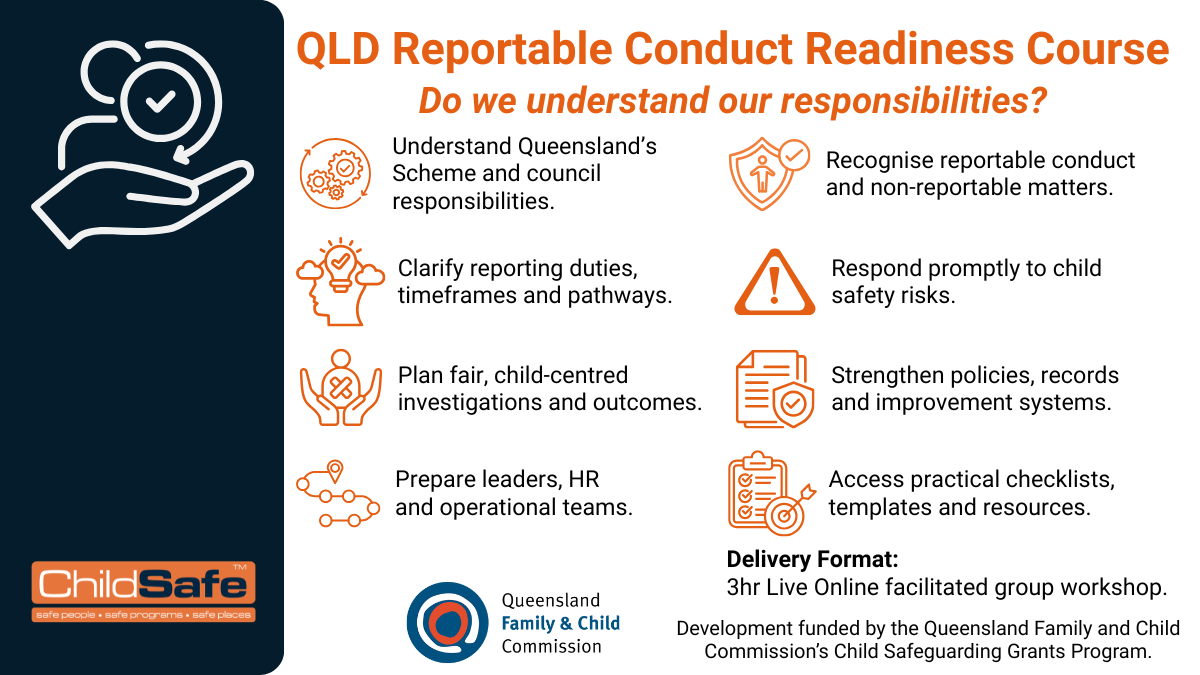
Queensland’s Reportable Conduct Scheme introduces new responsibilities for organisations that work with children and young people. For organisations covered by the Scheme, the challenge is not simply understanding the legislation. It is ensuring leaders, safeguarding personnel, HR teams and compliance leads know how to identify, assess, report and respond when concerns are raised about a worker’s conduct.

The Scheme requires reporting entities to take allegations seriously, prioritise the safety and wellbeing of children and young people, manage risks, notify the Queensland Family and Child Commission within required timeframes, conduct fair investigations and implement improvements where concerns are identified.

The QLD Reportable Conduct Readiness Course is a practical workshop style course designed to help organisational leaders understand their obligations and prepare the systems, processes and people needed to respond confidently and appropriately.

Using realistic examples and guided reflection questions, participants will build a clear understanding of reportable conduct, reporting pathways, investigation responsibilities, record keeping and organisational readiness.

ENQUIRE ABOUT TRAINING

Is Your Organisation Ready?

If an allegation involving a worker was received tomorrow:

  • Would your organisation recognise whether it may be reportable conduct?
  • Is your Head of Entity clearly identified and aware of their responsibilities?
  • Do staff, volunteers, contractors and leaders know how to raise concerns?
  • Are your internal escalation and external reporting pathways clear?
  • Can your organisation assess and manage immediate risks to children and young people?
  • Does your organisation have the capability to conduct a fair, timely and child-centred investigation?
  • Are there clear alternatives if an allegation involves the Head of Entity?
  • Do your policies, procedures and record-keeping systems support compliance with the Scheme?

This course helps organisations answer these questions before an allegation arises.

Ideal Participants

This course is designed for:

  • Heads of Entity, including CEOs, principals, senior officers and equivalent leaders
  • Executive Leaders and senior managers
  • Management, Board Members, Senior Leadership
  • Child Safety Officers, Safeguarding Leads and Child Protection Officers
  • HR, People and Culture, risk and compliance personnel
  • Governance professionals and Board members
  • Managers responsible for complaints, investigations or workforce conduct
  • Program leaders and operational managers
  • Staff responsible for implementing child safety policies and procedures

Participants Will:

  •  Understand the purpose and scope of Queensland’s Reportable Conduct Scheme.
  • Identify whether their organisation is a reporting entity under the Scheme.
  • Clarify the responsibilities of the Head of Entity and authorised delegates.
  • Recognise the categories of conduct that may be reportable.
  • Distinguish reportable conduct from reasonable behaviour management, care or other non-reportable matters.
  • Understand when and how to notify the Queensland Family and Child Commission.
  • Apply key reporting timeframes for initial, interim and final reports.
  • Identify immediate child safety, worker, organisational and information-management risks.
  • Understand the principles of fair, child-centred and procedurally fair investigations.
  • Assess whether their organisation has the systems needed to prevent, report, investigate and respond to reportable conduct.

Course Structure

Section 1 – Foundations

  • Overview of Queensland’s Reportable Conduct Scheme
  • Reporting entities, workers and Heads of Entity
  • Responsibilities, delegates and key definitions
  • Historical conduct and former workers

Section 2 – What Is Reportable Conduct?

  • The six categories of reportable conduct
  • Conduct inside and outside the workplace
  • Reasonable care, behaviour management and non-reportable matters
  • Practical examples and knowledge checks

Section 3 – When and How to Report

  • Reportable allegations, convictions and reasonable belief
  • Initial, interim and final reporting requirements
  • Other reporting obligations and notification pathways
  • Documentation, secure record keeping and risk information

Section 4 – Reportable Conduct Scheme Procedure

  • Receiving, assessing and notifying concerns
  • Immediate risk assessment and child safety actions
  • Planning and conducting investigations
  • Finalising findings, reporting outcomes and implementing actions

Section 5 – Embedding Systems

  • Preventing reportable conduct through child safe systems
  • Accessible reporting pathways for workers, children and families
  • Alternative pathways when concerns involve the Head of Entity
  • Investigation, response and continuous-improvement systems

Section 6 – Resources and Next Steps

  • QFCC guidance and implementation resources
  • Organisational readiness tools and checklists
  • Reporting process resources and practical templates
  • Identifying next steps for implementation
ENQUIRE ABOUT TRAINING

Course details

QLD Reportable Conduct Readiness Course

Course duration

2.5 – 3 hrs

Course delivery

Face-to-face, live online or hybrid delivery

Developed By

ChildSafe Australia

Facilitator

ChildSafe Australia Consultant

Group Size

Suitable for small group workshops through to organisational cohorts

Format

Facilitated discussion, practical activities, scenario analysis, reflection exercises, templates and Q&A

Queensland Alignment

Queensland Reportable Conduct Scheme and Child Safe Organisations system

Resources Included

Readiness tools, reporting pathway guidance, practical checklists and links to further QFCC resources

Certificate on completion

Certificate of Completion available on successful completion