Course Overview
Queensland’s Reportable Conduct Scheme introduces new responsibilities for organisations that work with children and young people. For organisations covered by the Scheme, the challenge is not simply understanding the legislation. It is ensuring leaders, safeguarding personnel, HR teams and compliance leads know how to identify, assess, report and respond when concerns are raised about a worker’s conduct. This QLD reportable conduct scheme course has been developed specifically for reporting entities operating in Queensland, to help them meet these obligations with confidence.
The Scheme requires reporting entities to take allegations seriously, prioritise the safety and wellbeing of children and young people, manage risks, notify the Queensland Family and Child Commission within required timeframes, conduct fair investigations and implement improvements where concerns are identified.
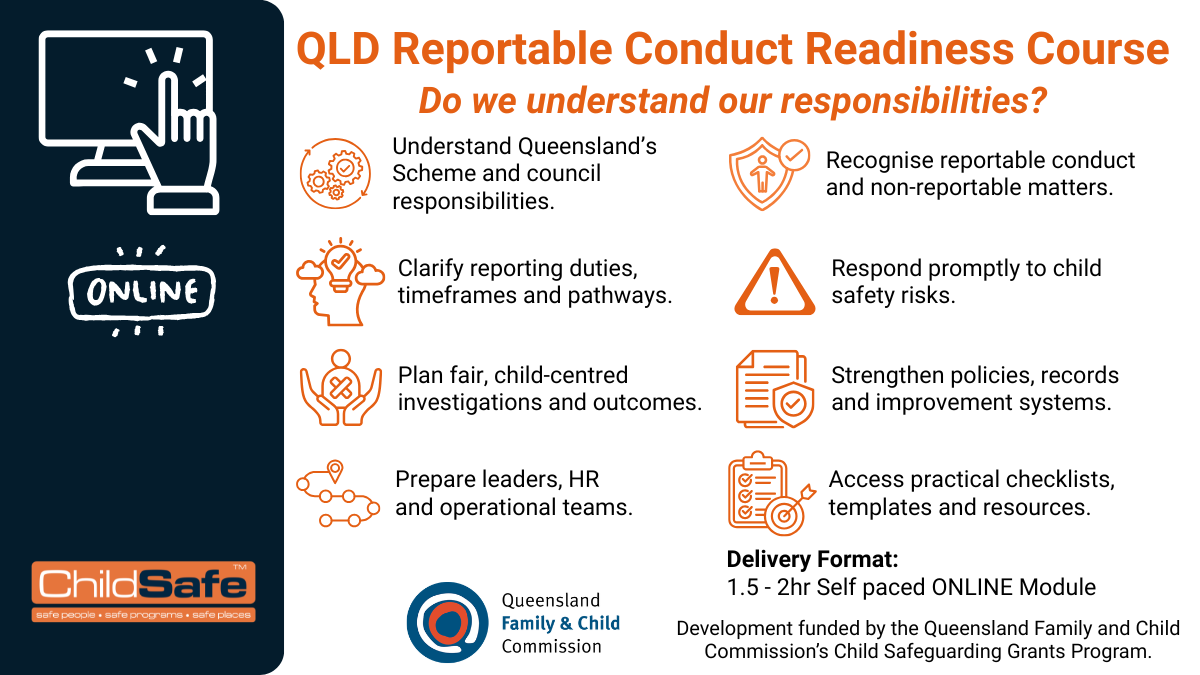
The QLD Reportable Conduct Readiness Course supports organisations to understand and prepare for their responsibilities under the Queensland Reportable Conduct Scheme.
This self paced course provides practical guidance on recognising reportable conduct, assessing allegations and convictions, meeting notification timeframes, managing risk, conducting fair and child-centred investigations, and establishing the organisational systems needed for ongoing compliance.
Learners apply the course content through interactive activities, knowledge checks and the progressive Sandy Bay case study.
For organisations that need broader support beyond training, our consulting services can help embed these changes across the organisation.
You can also see our QLD Child Safety Lead Officer Workshop.
Practical Resources:
Guides + Resources + Practice Case Study
More than just theory, this course equips learners with practical resources to support their organisation’s reporting responsibilities, including;
- a Queensland Reportable Conduct Scheme Readiness Checklist
- an Investigation Plan template
- downloadable course summaries.
Throughout the course, learners also work through the progressive Sandy Bay case study, applying their knowledge to realistic decisions involving the assessment of concerns, reporting timeframes, risk management, investigation planning and organisational improvement. This hands-on approach helps learners practise and refine the skills they will need to respond confidently and effectively when a concern arises.
Is Your Organisation Ready?
If an allegation involving a worker was received tomorrow:
This course helps organisations answer these questions before an allegation arises.
Ideal Participants
This course is designed for:
1. Foundations of the Reportable Conduct Scheme
Participants are introduced to the legislative and safeguarding foundations of the Queensland Reportable Conduct Scheme, including:
- The Child Safe Organisations Act 2024
- The purpose of the Reportable Conduct Scheme
- The role and oversight functions of the Queensland Family and Child Commission
- The meaning of key terms, including reporting entity, head of entity, allegation and worker
- Organisations and sectors covered by the Scheme
- The broad range of workers covered, including employees, volunteers, contractors, consultants, trainees, work-experience students and religious leaders
- The application of the Scheme to former workers and certain historical conduct
- The responsibilities of the head of the reporting entity
2. Recognising reportable conduct
Participants explore the six categories of reportable conduct and how they apply in practice:
- A child sexual offence
- Sexual misconduct committed in relation to, or in the presence of, a child
- Ill-treatment of a child
- Significant neglect of a child
- Physical violence committed in relation to, or in the presence of, a child
- Behaviour that causes significant emotional or psychological harm to a child
The course also considers:
- Conduct occurring inside and outside the workplace
- One-off incidents and patterns of behaviour
- Criminal and non-criminal conduct
- Professional boundaries and inappropriate behaviour
- Conduct that may not meet the reportable-conduct threshold
- The importance of assessing conduct in context and against organisational policies and professional standards
3. When and how to report
Participants learn when an organisation’s reporting obligations are triggered and what information must be provided, including:
- The allegations-based nature of the Scheme
- Forming a reasonable belief based on available facts and information
- The distinction between an allegation, an investigation and a substantiated finding
- Identifying and responding to reportable convictions
- Initial notification to the Commission within three business days
- Providing investigator details as soon as practicable
- Providing an interim report within 30 business days
- Providing the final investigation report as soon as practicable
- Information required at each reporting stage
- Notifications to Police, child-protection authorities, Blue Card Services, professional bodies and other regulators
- Clear, accurate, secure and complete record keeping
4. Responding to reportable conduct
Participants follow the end-to-end response and investigation process through three connected stages.
Stage 1: Receive, assess and notify
- Receiving and documenting an allegation
- Assessing whether the matter may involve reportable conduct
- Identifying immediate risks to children and other involved parties
- Implementing proportionate interim safeguards
- Preserving relevant information and evidence
- Notifying the Commission and other authorities
Stage 2: Plan, investigate and update
- Defining the allegation and investigation scope
- Selecting an appropriately skilled and impartial investigator
- Identifying and managing conflicts of interest
- Preparing an investigation plan
- Identifying witnesses, evidence and investigation questions
- Conducting child-centred and procedurally fair interviews
- Maintaining cultural safety, accessibility and confidentiality
- Reviewing risk controls as new information emerges
- Providing the Commission with an interim report
Stage 3: Finalise, report and take action
- Assessing the credibility, reliability and consistency of evidence
- Applying the balance-of-probabilities standard
- Making a clear finding for each allegation
- Preparing and submitting the final report
- Communicating outcomes and providing appropriate support
- Implementing employment, policy, practice and safeguarding actions
- Identifying systemic issues and opportunities for continuous improvement
5. Embedding effective organisational systems
Participants consider the policies, practices and procedures needed to support compliance and create a strong safeguarding culture, including systems that:
- Prevent reportable conduct
- Enable children, families, carers, workers and community members to raise concerns
- Provide clear and accessible internal and external reporting pathways
- Allow concerns involving the head of entity to be reported directly to the Commission
- Support timely, consistent and child-centred investigations
- Protect confidentiality and support whistleblowers
- Strengthen screening, recruitment, induction, training and supervision
- Embed the Queensland Child Safe Standards
- Use investigation outcomes to improve organisational practice
6. Resources and implementation tools
Learners receive access to practical resources to support implementation, including:
- ChildSafe’s Queensland Reportable Conduct Scheme Readiness Checklist
- ChildSafe’s example Investigation Plan template
- Downloadable summaries of the five core course sections
- Links to Queensland Family and Child Commission guidance
- Additional child-focused complaint-handling resources
Learning approach
The course incorporates:
- Interactive explanations and activities
- Scenario-based decision-making
- Knowledge checks requiring correct responses
- Practical reflection activities
- A progressive Sandy Bay case study covering triage, notification, risk management, investigation planning, evidence assessment and organisational improvement